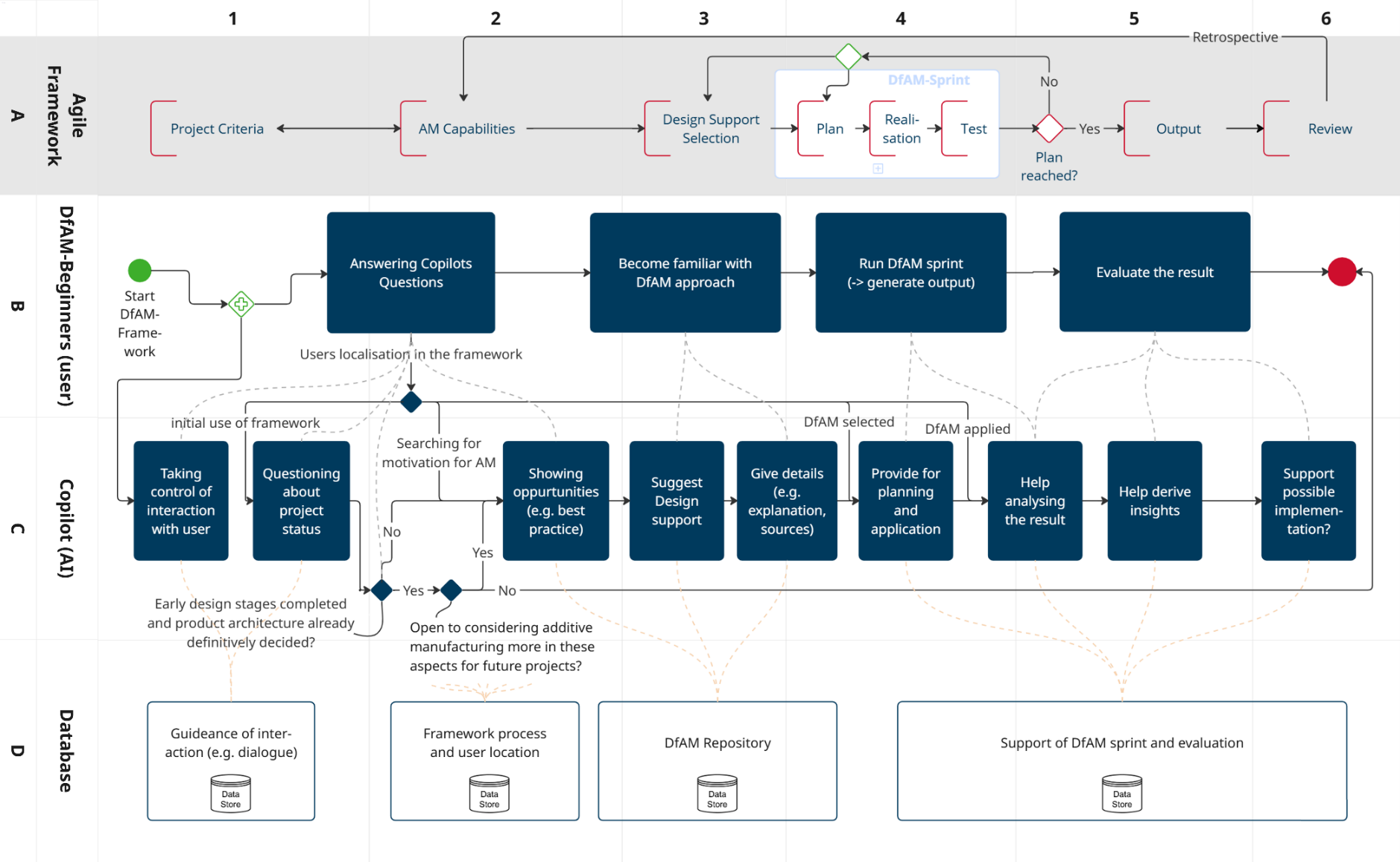
The structure of the DfAM-Copilot / framework
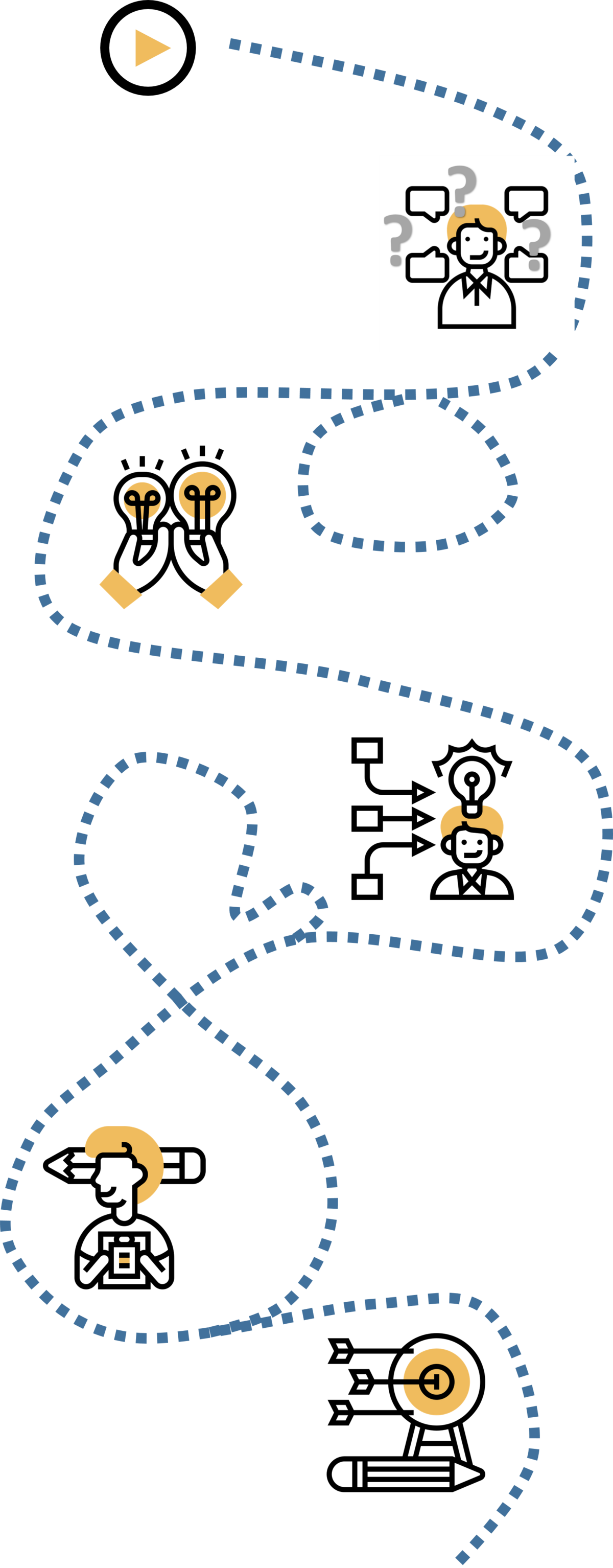
You can use the process by clicking through the steps on the starting page. This will automatically guide you through the process.
If you have any questions about the individual steps, you can find more information on the relevant subpages (Step 1, ...).
Basically, the process serves not only to assist in selecting a suitable methodological approach, but also to guide the activities before and after.
The framework can generally be used according to individual preferences and steps can also be omitted, but for seamless functionality, it is recommended to go through steps 1-4 in sequence.
For some steps, the user is directed to external sites (ChatGPT and Scopus). A separate account is required for both, but free versions are sufficient and therefore there are no costs for the user when using the framework.
Preliminary research
Own scientific publications
| RESEARCH QUESTION | PAPER TITLE | DOI |
| How can the potential of AM be exploited in product development? | Factors influencing the decisions of Conventional/Hybrid Lightweight DesignStrategies and their Effect on the Design Process | doi.org/10.1017/dsd.2020.181 |
| What are hot topics and Reasearch needs | Additive manufacturing research landscape: A literature review | doi.org/10.1017/pds.2021.34 |
| How can product architecture be fundamentally reconsidered through the use of DfAM? | Rethinking System Boundaries for Better Utilisation of AdditiveManufacturing Potentials – A Case Study | doi.org/10.1017/pds.2022.146 |
| How can the acquisition of knowledge and expertise in the field of DfAM be systematically supported? | A proposal for guiding the selection of suitable DfAM support based on experiential knowledge | doi.org/10.1017/pds.2024.185 |
| Artificial intelligence supported knowledge extraction in design for additive manufacturing: a proof of concept | k.A. | |
| What aspects do DfAM novices particularly value when working with a human or technological expert system? | AI as a copilot: Novice perceptions of expert support in early design for additive manufacturing | k.A. |
Background information about the framework (basis of the DfAM-Copilot)
The structure of the framework is based on an approach that is inspired by an agile framework called scrum You can find further information about it in this paper. If you are interested in learning more about the development of the framework, you can read about its creation another publications (coming soon). The BPMN diagram below shows the framework of the the basic structure process. The four lanes (a-d) represent the main elements / actors.
Lane A represents the structure of the original agile approach (and thus bears a certain resemblance to the framework on the home page).
Lane B describes the activities of the user (i.e. you).
Lane C describes the activities that are implemented by self-configured AIs (in ChatGPT).
Lane D shows what content the databases must provide to ensure the functionality of the entire framework.